
AI for Future Looking Business Leaders - (Beyond the Hype)


If it feels like every business strategy conversation has quietly become an AI conversation, you’re not imagining it.
We’re entering a phase where the economic reality of AI will collide with how enterprises actually operate.
Business executives feel the pressure to "have an AI strategy"…
…while very few have a clear picture of what AI business reality will look like over the next 2–3 years.
When JPMorgan Asset Management reported that AI spending accounted for two-thirds of US GDP growth in the first half of 2025, it wasn’t just a headline. It was a warning shot.
It is a signal: AI is no longer an just an experiment on the edge of the business.
That’s the signal I’m paying attention to.
If that much of macro growth is being attributed to AI investment, then in the next few years:
1. Business leaders will expect visible AI impact on P&L
2. Capital will favour AI-mature organizations
3. “We’re experimenting” will stop being an acceptable status update
What’s really happening beneath the hype
At the same time, leaders like Sam Altman, Jeff Bezos, and David Solomon have been openly acknowledging that the market will overshoot in some areas and under appreciate others.
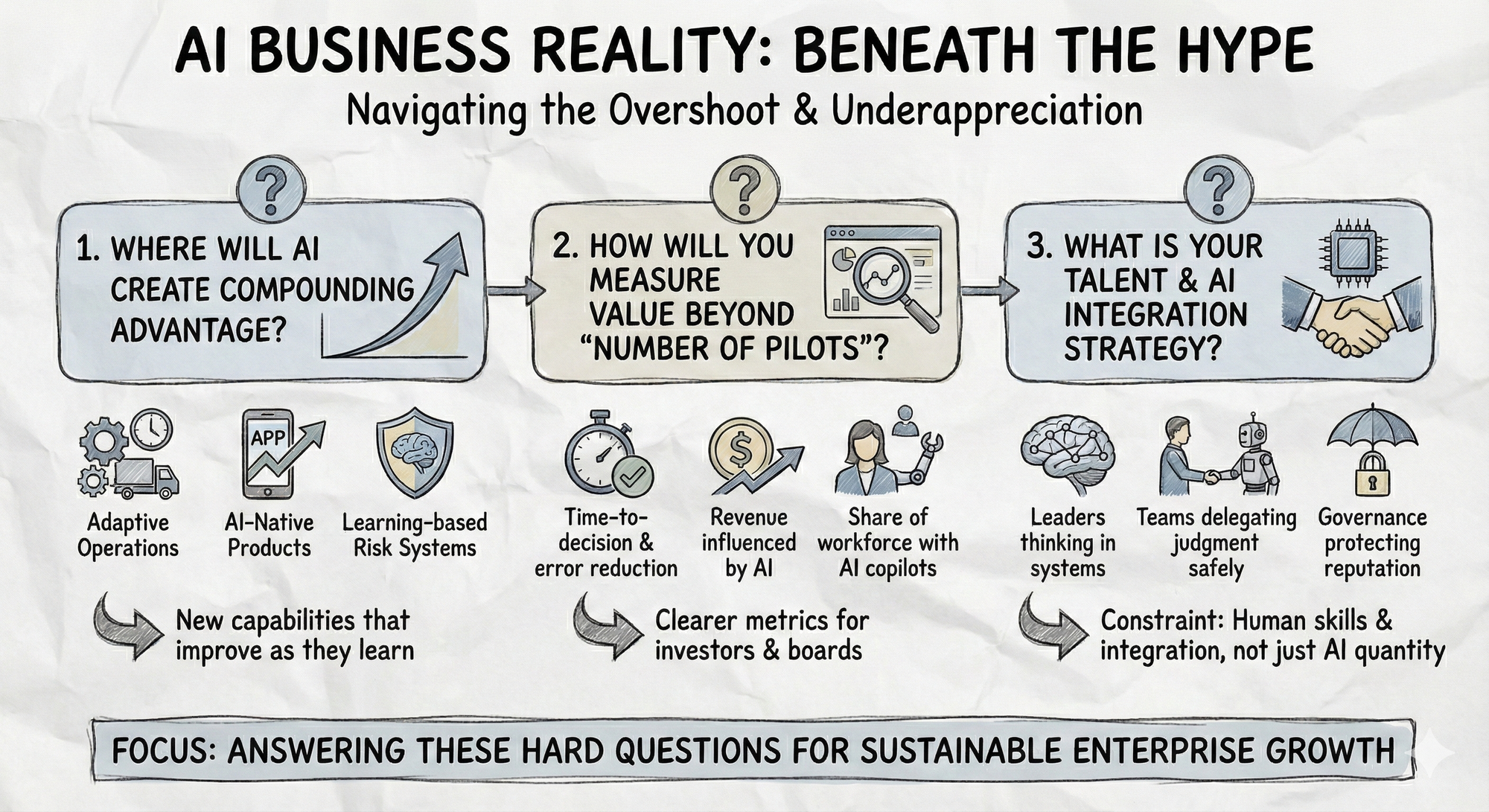
The AI business reality for enterprise leaders over the next few years won’t be about who used the most models. It will be about who answered three hard questions:
1. Where will AI create compounding advantage?
Not just cost takeout, but new capabilities that get better as they learn:
- Adaptive operations that continuously re-optimize logistics, staffing, and inventory
- AI-native products that improve every week based on real usage
- Learning-based risk systems that keep your downside in check as you scale automation
2. How will you measure value beyond “number of pilots”?
With AI contributing such a large share of GDP growth, investors and boards will push for clearer metrics:
- Time-to-decision and error rate reduction in key workflows
- Percentage of revenue influenced by AI-augmented journeys
- Share of workforce operating with AI copilots as standard tools
3. What is your talent and AI integration strategy?
The constraint won’t just be the amount of AI being used. It will be:
- Leaders who can think in systems, not just slides
- Teams who can safely delegate judgment to machines and know when not to
- Governance that protects customers and reputation without killing experimentation
What this means for enterprise leaders
Over the next 2–3 years, AI will stop being a discrete initiative and start becoming:
- A structural cost line – like energy or cloud, not a pilot budget.
- A requirement for competitiveness – not a nice-to-have experiment.
- A strategic dependency – on a small set of core platforms and providers.
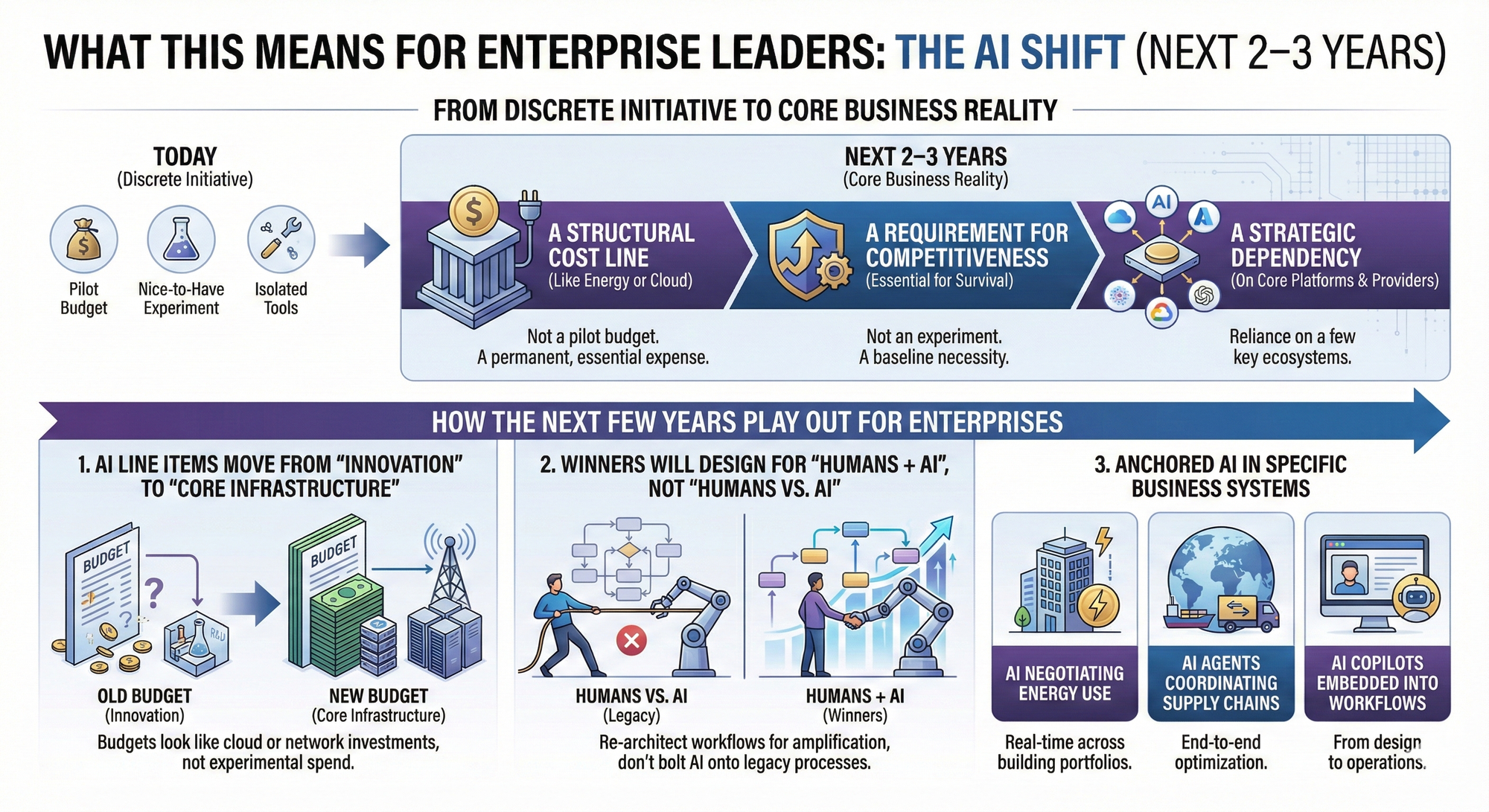
Here’s how I see the next few years playing out for enterprises:
AI line items move from “innovation” to “core infrastructure.”
Budgets will look less like experimental spend and more like cloud or network investments.
Winners will design for “humans + AI,” not “humans vs. AI.”
The most productive organizations will be the ones that re-architect workflows so people and models amplify each other, instead of bolting AI onto legacy processes.
Anchored AI in specific business systems
Instead of generic “AI for efficiency,” we’ll see:
- AI negotiating energy use in real time across building portfolios.
- AI agents coordinating supply chains end-to-end.
- AI copilots embedded into every critical workflow, from design to operations
My take: The real advantage will come from “AI-shaped businesses”
In a few years, the competitive gap won’t be between companies that use AI and those that don’t.
It will be between companies that re-architect themselves around AI and those trying to bolt it on.
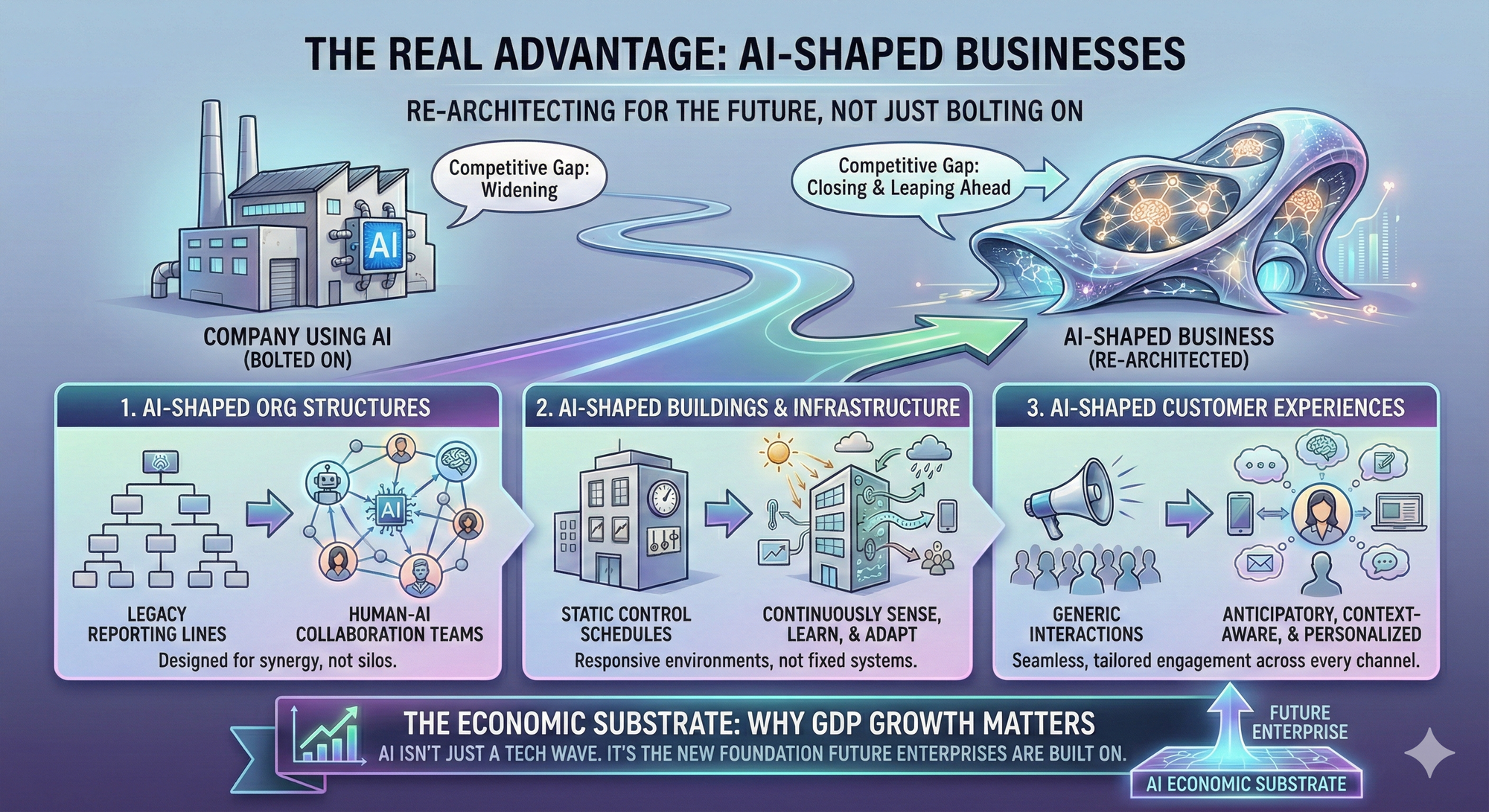
I’m expecting to see:
- AI-shaped org structures – where teams are designed around human–AI collaboration, not legacy reporting lines.
- AI-shaped buildings and infrastructure – where environments continuously sense, learn, and adapt to people and weather, not static control schedules.
- AI-shaped customer experiences – where interactions feel anticipatory, context-aware, and personalized across every channel.
This is why that “two-thirds of GDP growth from AI spend” datapoint matters so much:
It tells us AI isn’t just a new technology wave.
It’s a new economic substrate that future enterprises will be built on.
A Practical Takeaway for Leaders Right Now
Instead of asking, “What’s our AI strategy?” I’d start asking:
“If AI will be responsible for a large share of value creation in our industry, what will our business look like when that’s true?”
Then work backward:
- Identify 2–3 core systems (operations, customer, infrastructure) that would look fundamentally different with AI at the center.
- Define what data, architecture, and skills you’d need to make that real.
- Start small – but design every pilot as a step toward that future state, not a one-off experiment.
Because AI isn’t just another tool to plug in.
It’s the design constraint for the next generation of businesses.
💬 How do you think your organization will need to re-architect itself as AI becomes a primary driver of economic growth rather than a side project in IT?
#AI #DigitalTransformation #EnterpriseStrategy #FutureOfWork #Leadership